The support ops teams we talk to are rarely starting from zero on AI. Most of them have already tried something — a bot, a platform add-on, a chatbot deployment that seemed promising in the demo — and it didn't work. Some of them have visible CSAT damage to show for it. The customers who encountered the bad AI deployment haven't forgotten, and their survey responses reflect it months later.
Recovering CSAT after a bad AI rollout is a specific operational challenge, and it's different from the standard CSAT improvement playbook. You're not just improving support quality from a baseline — you're actively rebuilding trust with a customer segment that learned not to trust your AI, and possibly not to trust your support channel in general. That requires a sequenced approach, not just better technology.
Why Bad AI Deployments Leave Lasting CSAT Damage
A bad AI experience creates a category of harm that a slow human response doesn't. When a customer waits 6 hours for a human reply, they're frustrated with response time. When a customer interacts with an AI that confidently gives wrong information, sends them in circles with irrelevant responses, or traps them in a loop they can't escape from, they're frustrated with the company's judgment. The failure isn't just inconvenient — it signals that the company made an active choice to deploy something that didn't work, and the customer bore the cost of that choice.
That distinction matters for recovery strategy. Improving response time fixes a throughput problem. Rebuilding trust after a judgment failure requires demonstrating changed judgment — different behavior that the customer can observe and feel.
Common patterns in bad AI deployments that produce lasting damage: bots that loop customers when they ask for a human (customers feel trapped), bots that give confident wrong answers without escalating (customers feel deceived), bots that collect detailed information then still transfer to a human with no context (customers feel their time was wasted), and bots with no graceful failure mode — they don't know what to do when they're stuck, so they just keep trying variations of the same unhelpful response.
Phase 1: Triage — Stop the Bleeding Before Rebuilding
Before any CSAT recovery strategy can work, the source of damage has to stop. If the bad AI deployment is still live and still producing poor experiences, recovery efforts will be offset by ongoing harm. The first decision is whether to shut down the AI layer entirely and revert to human handling, or to narrow its scope drastically to only the interactions where it's performing well.
The narrowing approach is usually preferable to full shutdown if the AI is performing well in any categories. Suppose the bad deployment is good at answering basic product FAQs but terrible at anything involving account-level data or action requests. Route only FAQ interactions through it, with a clearly visible "talk to a real person" option always available — not hidden, not requiring multiple clicks to reach. For everything else, route direct to human agents.
The visible escalation path matters psychologically. Customers who've had a bad AI experience need to see immediately that getting to a human is easy. If the first thing they encounter is the same bot experience they struggled with before, many will disengage before even trying. A prominent, low-friction "connect me with a person" option is a trust signal that costs you some deflection but starts rebuilding credibility.
Phase 2: Identify and Prioritize the Damaged Segment
Not all customers were affected equally by the bad deployment. Pull CSAT data from the period when the bad AI was live and look for the customers who had the most adverse experiences — low CSAT scores, multiple contacts in a short period, escalations that should have happened automatically. These are the accounts to prioritize in active outreach.
We're not saying you need to personally apologize to every customer who had a sub-par AI interaction. But the accounts that had repeated failures in a short window — three or more contacts that didn't resolve, plus a CSAT below 3 — are the highest churn risk. A proactive outreach from a human team member, acknowledging the experience and offering a direct resolution path for any outstanding issues, converts a meaningful percentage of at-risk accounts back to stable.
The copy matters here. Don't describe the AI as a "technical issue" or a "system problem." That framing implies something went wrong externally. What actually happened was that the company deployed something that wasn't ready. Customers who had bad experiences often feel the company already knows their product wasn't working — being vague or evasive about the reason for outreach reads as spin. Straightforward acknowledgment performs better in our experience: "We rolled out AI support earlier this year and we made some mistakes in how it handled requests like yours. We've rebuilt the system. I wanted to reach out directly to make sure any open issues are fully resolved."
Phase 3: Instrument the New Deployment for Trust
When you re-introduce AI support — whether with a rebuilt version of what you had or with a different product entirely — the technical architecture needs to be designed with visible reliability, not just backend accuracy. Customers coming from a bad prior experience are more attuned to anything that feels like the old failures. Small friction points that a first-time AI user might ignore will register as warning signs to a burned customer.
Three architectural decisions that directly affect perceived reliability after a trust failure:
Explicit uncertainty acknowledgment. When the agent isn't confident, it should say so plainly — "I want to make sure I give you accurate information on this; let me connect you with our team" — rather than attempting a response that might be wrong. Visible fallback is more trust-building than invisible overreach.
Context preservation on escalation. If a customer ends up talking to a human, the human should already know everything the AI interaction established. No re-explaining. The escalation handoff should be smooth enough that the customer barely notices the transition. This single experience point — "the human already knew my situation" — does more to rebuild AI trust than almost any other factor we've observed.
Transparent action confirmation. When the AI takes an action — processes a refund, changes a subscription, sends a reset email — it should confirm the action with specific details, not just "Done!" A message like "I've issued a refund of $23.80 to your Visa ending in 4217. You should see it within 2–3 business days" is more trust-building than generic success confirmation. The specificity signals that the system actually did the thing, rather than claiming it did.
How Long CSAT Recovery Takes
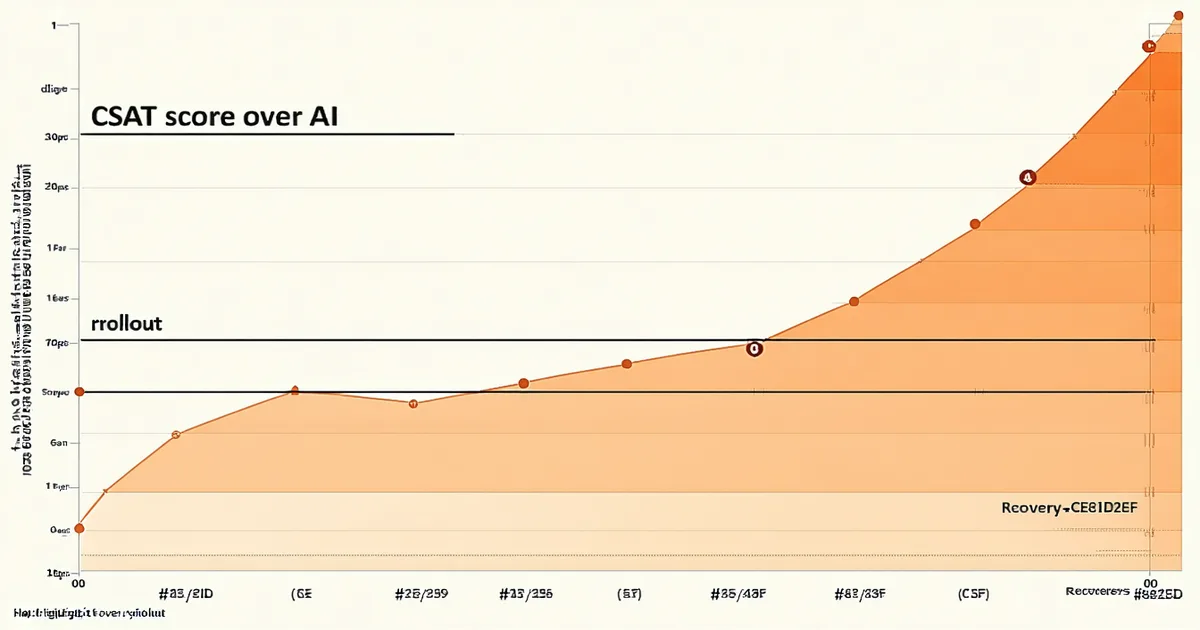
In our experience working with teams post-bad-deployment, CSAT recovery in the affected customer segment takes 3–5 months of consistently good AI experiences to return to pre-deployment baseline. The rate of recovery depends heavily on how proactive the outreach phase was and how visibly different the new system's behavior is from the old.
Teams that do nothing except swap out the technology typically see partial recovery over 6–9 months as the customer base turns over. Teams that combine technical improvement with active outreach to the damaged segment typically recover faster — closer to 3–4 months — and see higher retention on the at-risk accounts specifically.
The lagging indicator to watch: CSAT on AI-assisted interactions specifically, not blended CSAT. Blended CSAT can look fine while AI-assisted CSAT remains depressed, because customers who had bad AI experiences route themselves to human agents and the human CSAT pulls the overall number up. Surface the AI-specific CSAT separately so you can see the recovery curve clearly rather than having it masked by channel-switching behavior in the customer segment you most need to reach.