The conversations that end badly in AI-assisted support almost never start with a hallucination or a wrong answer. They start with an escalation that didn't happen when it should have — or one that happened when it shouldn't have. The content the AI produced was fine. The decision about whether to hand off to a human was wrong. That decision is the escalation policy, and most teams design it as an afterthought.
Escalation policy is where autonomous support systems build or destroy customer trust. Get it right and customers experience AI as a relief — fast resolution, no friction, no waiting. Get it wrong and customers experience AI as a wall they have to get past to reach a human being. One of those experiences creates loyalty. The other creates churn.
Why Binary Escalation Logic Fails
The default approach to escalation is binary: the AI handles it, or the human handles it. Teams draw that line by ticket type. Billing questions to the bot. Complex issues to humans. Cancellations to humans. Everything else to the bot.
This fails for a predictable reason: customer situations don't fit neatly into categories. A billing question that involves a disputed charge from a customer who just posted a negative review is not the same conversation as a billing question from a first-time customer asking about their first invoice. The ticket category is identical. The escalation needs are completely different.
Context-blind routing — which is what category-based escalation is — misroutes constantly. It over-escalates simple variants of sensitive categories (adding load to human agents on issues that could resolve automatically) and under-escalates complex variants of routine categories (leaving frustrated customers stuck with a bot that can't meet the moment).
The right model isn't "which ticket types go to humans" but "which conditions warrant a human." Conditions are richer than categories, and they can be evaluated dynamically as the conversation evolves.
The Four Escalation Triggers That Matter
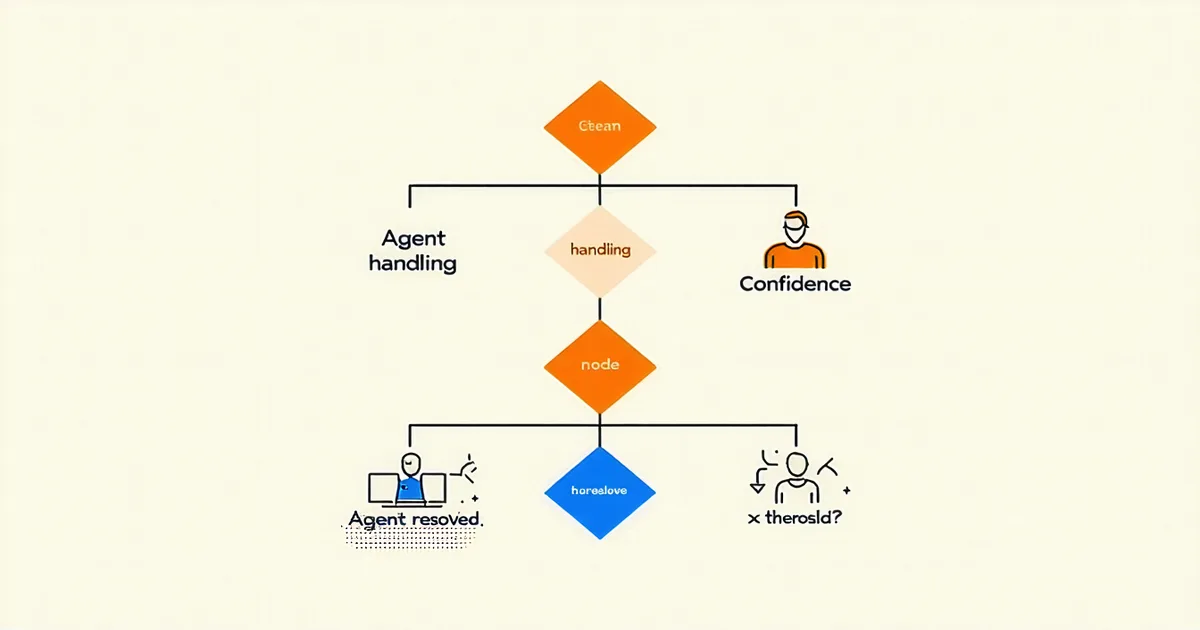
Across well-designed escalation architectures, four condition classes recur as the reliable triggers for human handoff.
Confidence threshold breach. When the agent's intent classification confidence falls below a defined threshold for a proposed action, escalate before acting. The threshold should vary by action consequence: higher bar for financial transactions, lower bar for informational responses. A common misconfiguration is using a single flat threshold across all action types. That's too aggressive for routine lookups and too permissive for account-level changes.
Sentiment signal. Repeated negative sentiment markers — explicit frustration expressions, multiple clarification requests, short hostile replies — are a reliable predictor that the current conversation is not going to resolve cleanly. Good systems detect this before the customer explicitly asks for a human and proactively offer the transfer. Waiting for the customer to say "I want to speak to a real person" is already too late; by that point the CSAT is lost regardless of what happens next.
Policy boundary hit. When the requested action exceeds the agent's defined authorization scope — refund over a dollar threshold, account access to a non-primary email, cancellation of an enterprise contract — the agent should escalate immediately and transparently. "This request requires a quick review from our team — I'm connecting you now with full context from our conversation." That's better than attempting to handle it and either failing awkwardly or taking an unauthorized action.
Repeated contact pattern. A customer who contacts support three times in seven days about the same issue is a qualitatively different situation than a first-contact. The agent should detect that repeat-contact pattern and treat it as an automatic escalation signal, even if the current request looks routine. Teams we've worked with have found that routing repeat-contact customers directly to human agents — with the conversation history surfaced — dramatically outperforms routing them back through the automated queue.
Designing the Handoff Itself
The quality of an escalation isn't just about when it happens — it's about how it happens. A well-timed escalation that loses all context when it transfers destroys most of the value the automated first stage created. The customer ends up explaining their problem again from scratch. The human agent has no idea what the bot already tried. That's swivel-chair dynamics inside a single support interaction.
The handoff package the agent delivers to the human should include: the customer's account state at the time of escalation, a summary of what the agent attempted, the specific reason for escalation (confidence breach, sentiment flag, policy boundary, etc.), any account flags or history that are contextually relevant, and a pre-populated ticket draft so the human agent can begin working without a setup phase.
Teams that instrument this carefully consistently see average handle time on escalated tickets drop significantly compared to cold-start tickets. The human agent's work is more focused, the customer doesn't re-explain, and resolution is faster even though the ticket required human involvement.
The Calibration Loop: Escalation Policy Is Never Done
We're not saying you can design a perfect escalation policy before you've run any live traffic. That's not how these systems work. Escalation thresholds need calibration against real interaction data, and that calibration is ongoing.
The diagnostic signals to track: escalation rate by ticket category (a category with unusually high escalation rates signals either misaligned confidence thresholds or a knowledge gap), human agent resolution rate on escalated tickets (if human agents are also struggling, the problem isn't the escalation trigger — it's a policy or tooling problem), and customer sentiment on escalated vs. directly-resolved tickets.
Practically, run a monthly calibration review. Pull the previous month's escalation events, classify them by trigger type, and ask whether each trigger produced a correct decision. A false escalation (agent escalated a ticket that a human resolved in under 2 minutes with no special expertise) suggests your confidence threshold is too low. A missed escalation (ticket was not escalated and the customer reopened within 48 hours) suggests a sentiment detection gap or a policy boundary that's drawn too wide.
Escalation as a Trust Signal, Not a Failure Mode
One mental model shift that changes how teams design escalation: stop treating escalation as a failure mode. An escalation isn't the AI admitting defeat — it's the system correctly recognizing that a given situation warrants human judgment and routing accordingly. A support organization that escalates 15% of contacts with high accuracy and context-rich handoffs is performing better than one that escalates 5% but misses half the situations that needed human involvement.
Customers who are escalated appropriately — quickly, without having to demand it, with full context carried over — report higher CSAT than customers whose issues were resolved by the AI without escalation. Not because they prefer talking to humans, but because the act of being escalated feels like the system understood that their situation was important. That perception is what builds trust, and trust is the asset that makes AI support a long-term competitive advantage rather than a short-term cost play.
Design your escalation policy like a rule system, not a routing table. Test it against your real edge cases before go-live. Calibrate it monthly against data. And measure it on customer outcome, not on escalation volume.